Executive Summary
Enterprises must convert dispersed customer experience signals into actionable operational intelligence or risk slower decisions and escalating costs. This requires a consolidated CX data fabric, governed semantic layer, and reporting pipelines that translate event-level telemetry into business-ready metrics. Operationalizing those metrics demands process mining, targeted automation, and a cross-functional execution model with clear ownership and SLAs. Scalability depends on modular infrastructure, event-driven integrations, and cost-aware observability. The outcome is faster cycle-times for remediation, predictable capacity for peak demand, and measurable ROI from continuous process optimization. Executives should prioritize a phased program—data foundation, controls and governance, targeted automation, and measurement—to lock value and reduce transformation risk.
Techstello Insights
Aligning CX measurement to strategic outcomes
Customer experience data is often abundant and poorly aligned to the decisions leaders must make. Call transcripts, session logs, NPS pulses, CRM events and backend process traces exist in separate silos with inconsistent definitions. The strategic error is treating reporting as a retrospective artifact rather than as an operational control. To change that, organizations must define a business-focused metric taxonomy that maps experience signals to outcomes such as retention, revenue at risk, or time-to-resolution. That taxonomy becomes the anchor for a semantic layer that enforces consistent definitions across reports, dashboards and automation triggers.
Reframing measurement as a decision enabler forces trade-offs and prioritization. Not every metric needs real-time latency; some require daily aggregation while remediation triggers demand streaming alerts. Establishing these tiers reduces cost and clarifies engineering effort. Equally important is mapping metrics to accountable process owners and escalation paths so that visibility converts to action rather than passive dashboards.
Operational implementation realities
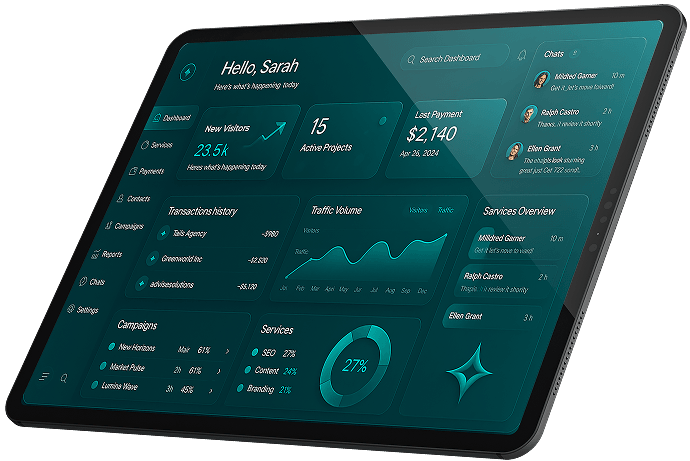
Implementation is a systems problem, not a single-team project. At the data layer this means an event-driven ingestion pipeline, a unified customer identifier strategy, and an auditable transformation layer that writes business-ready aggregates. Practically, enterprises benefit from a reporting fabric pattern: reusable ingestion, governed transformations, a semantic layer for business queries, and a delivery layer for visualizations and APIs. This reduces duplication and accelerates new reports without ad hoc engineering work.
Governance and execution cadence are equally critical. A CX reporting program needs clear SLAs for data freshness, a change-management process for metric updates, and a lightweight center of excellence to arbitrate conflicts between product, ops and analytics teams. Process mining and workflow telemetry reveal bottlenecks that inform automation—targeting repetitive handoffs first—while capacity planning and cost visibility ensure scalability under peak loads. Without those controls, scaling reporting magnifies technical debt and operational ambiguity.
Enterprise implications and future readiness
When executed with discipline, optimized CX reporting converts into sustained commercial advantage. Teams gain faster root-cause diagnosis, reduced mean time to resolution, and trusted inputs for predictive models that prioritize interventions. Organizationally, the program reduces escalations by embedding measurement into daily operations and shifting the locus of control to operational leaders rather than isolated analytics teams. Looking ahead, a modular reporting fabric and governed semantic layer make it feasible to introduce probabilistic scoring, real-time orchestration, and closed-loop automations without rebuilding foundations.
Key Takeaways
- Define a business-focused metric taxonomy and enforce it with a governed semantic layer.
- Adopt a reporting fabric with event-driven ingestion and reusable transformations to limit duplication.
- Pair process mining with targeted automation to reduce cycle times and remove manual handoffs.
- Establish SLAs, a COE for governance, and cost-aware capacity planning to scale responsibly.
Techstello Angle
Techstello approaches CX optimization as a systems transformation: we design a governed reporting fabric, align metrics to operational owners, sequence automation using process telemetry, and enable scalable execution through modular infrastructure and governance.